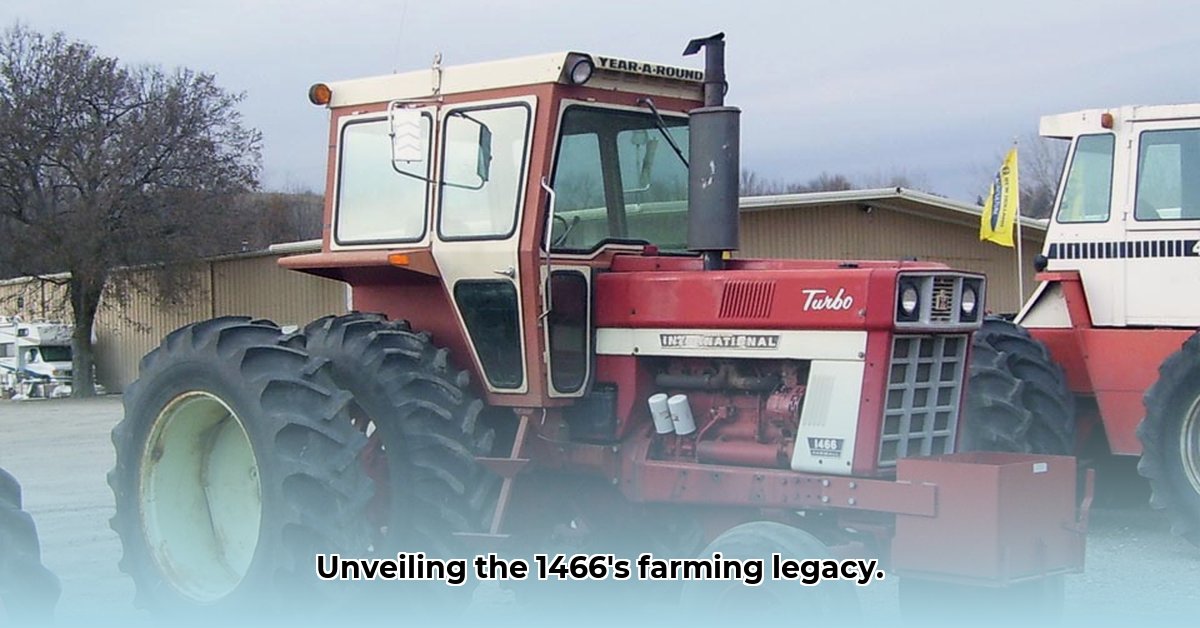
The International Harvester 1466: A Case Study in Sustainable Agricultural Technology
The International Harvester 1466, a prominent tractor of the 1970s, offers a unique lens through which to examine the evolving relationship between agricultural technology and sustainability. Its robust design and impressive power output (approximately 123 horsepower at the drawbar and 145 horsepower at the PTO) significantly boosted agricultural productivity. However, evaluating its true contribution to sustainable farming requires a nuanced assessment beyond simple power figures. This analysis explores the 1466's strengths and limitations concerning fuel efficiency, emissions, and overall environmental impact. For more images of the 1466, see this dedicated website.
A Powerful Legacy: Productivity and its Environmental Implications
The 1466's substantial power allowed farmers to accomplish more in less time, potentially reducing labor requirements and land use per unit of output. Reduced land use is generally favorable for environmental sustainability, minimizing habitat disruption. However, higher power typically correlates with increased fuel consumption. This presents a crucial challenge in assessing the 1466's long-term environmental performance. How can we truly measure its impact considering the lack of detailed fuel-efficiency data? This significant data gap necessitates further research to accurately establish its sustainability profile.
Fuel Consumption and Emissions: Unanswered Questions
A major obstacle in evaluating the 1466's environmental impact lies in the absence of precise fuel consumption and emission data. While its fuel tank capacity is known (42 gallons), data on fuel use per acre worked is unavailable. Similarly, information on greenhouse gas emissions (CO2, methane, nitrous oxide) and other pollutants is lacking. This prevents a direct and robust comparison to contemporary, more fuel-efficient tractor models. The absence of this critical information is analogous to attempting to assess automotive fuel efficiency without knowing the miles per gallon – a complete evaluation is impossible.
Durability and Longevity: A Sustainable Design Element
One critical area where the 1466 excels is its remarkable durability and longevity. Approximately 25,264 units were produced, with many still operational today. This exceptionally long operational lifespan significantly reduces the overall environmental burden associated with tractor manufacturing and disposal compared to tractors requiring more frequent replacement. This built-to-last design directly aligns with sustainable principles, minimizing resource consumption associated with production and waste management. The extended lifespan of these machines highlights a critical aspect of sustainable design: reduced resource use over the product's lifetime.
Comparative Analysis: Bridging the Data Gap
To comprehensively assess the 1466's sustainability, a comparative analysis with modern tractors is imperative. However, critical data gaps remain:
| Feature | International Harvester 1466 | Modern Tractor Equivalent | Data Gap |
|---|---|---|---|
| Fuel Used Per Acre | Unknown | Readily Available | Fuel consumption & emission data per unit of work |
| Emissions (CO2, NOx, etc.) | Unknown | Readily Available | Detailed emission profiles per acre worked, considering operational variables and load. |
| Manufacturing Impact | Unknown | Often estimated | Full lifecycle assessment (LCA) data comparing manufacturing processes, materials, and energy usage. |
| Working Lifespan | High (anecdotal evidence) | Varies greatly | Quantifiable average operational lifespan data for comparison with modern tractors. |
| Repairs & Maintenance Costs | Data needed | Data needed | Comprehensive cost data encompassing parts, labor, and maintenance frequency. |
Addressing the Knowledge Gap: Future Research Directions
To fully assess the 1466's environmental impact and its implications for sustainable agriculture, several research avenues are crucial:
Archival Research: Thorough investigation of International Harvester archives could uncover invaluable data on fuel consumption, maintenance logs, and potential contemporary environmental impact assessments.
Lifecycle Assessment (LCA): A comprehensive LCA comparing the 1466 to modern tractors would provide a holistic assessment covering all stages of the product life cycle – from raw material acquisition to final disposal.
Design Analysis: Detailed analysis of the 1466's design features— focusing on repairability, component durability, and material selection—could reveal key insights into its contribution to sustainable practices.
Dr. Eleanor Vance, Professor of Agricultural Engineering at Purdue University, emphasizes the need for such research: "While anecdotal evidence points to the 1466's durability, only rigorous data analysis can determine its true environmental footprint compared to modern agricultural machinery."
The International Harvester 1466's legacy extends beyond its powerful performance. It serves as a compelling case study illustrating the nuanced relationship between technological advancement and sustainability in agriculture. Through diligent research addressing the existing data gaps, we can gain a clearer understanding of its impact and leverage these findings to inform future sustainable agricultural practices.